

En español
You can also use the widget at the top of the page for an automatic translation.
1. Contact helplines. Get in touch with nonprofits that connect people to legal resources. Bringing your detained loved one to the attention of these organizations can help them get connected with qualified legal representation or advice. They can also provide more specific answers about your loved one’s case. If your loved one was detained, you can reach out to:
- National Immigration Detention Helpline, operated by Freedom for Immigrants, at 209-757-3733.
- The United Nations High Commissioner for Refugees (UNHCR) and American Bar Association at 202-442-3363. You can email the American Bar Association at [email protected].
- Legal aid for New York state: 212-577-3456, Wednesdays from 1pm–5pm.
- For New York City: 1-800-354-0365 (or call 311 and say, “Immigration Legal”), Monday–Friday, 9am–6pm.
2. Locate your loved one. Look up where ICE is keeping your loved one by going to https://locator.ice.gov and using their country of birth as well as either their A# OR their full name and birthday. Note that the website may not be up to date.
You can usually click on the name of the detention center to find out its contact information. If you click “more information,” you will be brought to an informational website that has sections about visitation, getting items to your loved one, and where to provide feedback or complaints.
You can also try to locate your loved one by calling ICE at 1-888-351-4024, but their phone lines’ performance are inconsistent; you might need to call them at different times.
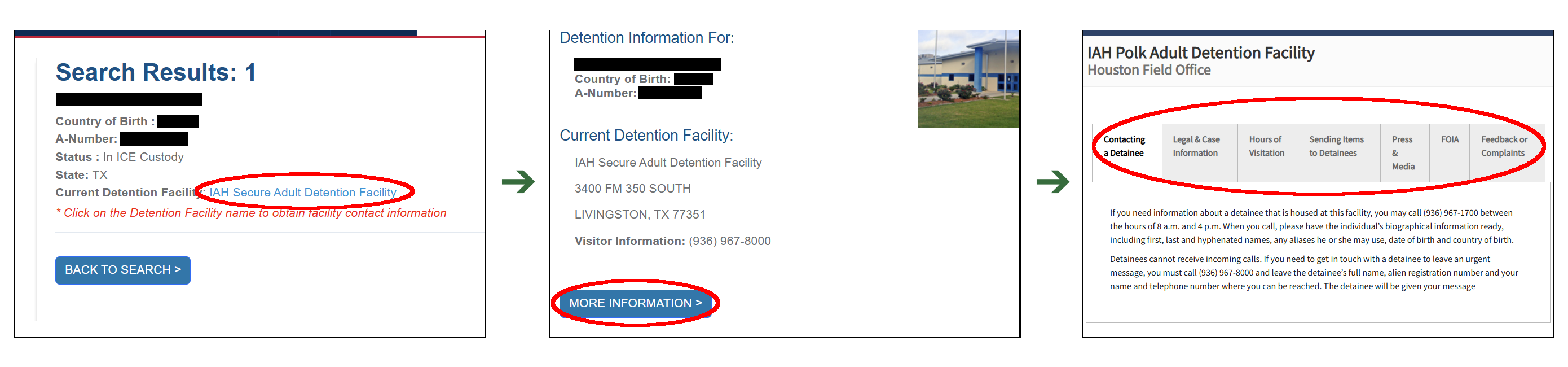
3. Visitation and material support. ICE’s detention center websites (which you can also browse here: https://www.ice.gov/detention-facilities) have sections for visitations as well as instructions to get items to your loved one in detention. This can be an opportunity to get helpful information to them, while providing essential emotional support.
You can also deposit money into your loved one’s detainee trust, which they can use to purchase necessities. Find the instructions to deposit via money order, cashier’s check, or Western Union here: https://www.ice.gov/doclib/detention/ADAMSMS-DepositInstructions.pdf. People in detention are entitled to have their trust moved with them if they move facilities. If ICE fails to transfer funds, report this to the detainee help hotlines, and be sure to report the issue with the contact information at the “Feedback & Complaints” section for the facility listed on the detention site (https://www.ice.gov/detention-facilities).
Your loved one is entitled to limited access to phones, but you can purchase more time to speak with them. Each detention center has its own system and will provide you details.
4. Support them as they fight their case. While in detention, your loved one can call hotlines by dialing 2150# (operated by American Bar Association) and 9233# (operated by Freedom for Immigrants). These numbers only work on detention center phones. They can also consult this guide for people in detention who represent themselves (or don’t yet have lawyers): bit.ly/prosedet.
Get the latest on your loved one’s case by using their A# to look them up on the EOIR website: https://acis.eoir.justice.gov/en/caseinformation/. The site will have the date and times of your loved one’s next hearing if they are still legally fighting deportation, as well as the name of their immigration judge. You can use the judge’s name to find the WebEx link at https://bit.ly/webexic and watch their hearings online. When signing into Webex, write in the name field that you are an “observer” as well as your loved one’s first name and the last three digits of their A#. (Example: “Bobby McLaren – observer for Jeffrey 555.”)
See a list of services that provide pro bono (free) services, including lawyers who can represent clients in immigration cases. Write down what happens when you call or email each of them, as immigration judges may be interested in the lengths you have gone to find a lawyer. (Short link: https://bit.ly/probonoimm.) See also a list of vetted local services and clinics.
5. Advocate. Write down the ERO (ICE’s Enforcement & Removal Operations) office numbers and detention center contact information from http://ice.locator.gov. You can call these numbers each day and calmly request information about your loved one. You can ask why they were detained, what ICE plans to do them, and when will they be released. Thank the person (or answering machine) you speak to and tell them you will call back for updates.
Got friends and family you can rely on? Have them call too, but let them know to remain calm when speaking.
Family members and lawyers for your loved one may be given more information, or be put in contact with a deportation officer. (If you are at risk of deportation or ICE detention, be cautious about giving new personal information about yourself to ICE.) If you are unable to get answers for a family member, ask to speak to a Community Relations Officer (CRO).
If your loved one has been deprived of anything, including the use of a phone, food or water, medical care, personal space, toiletries, or clean clothes, you can request that these things be provided.
Sometimes we hear that fear interviews (credible or reasonable) to restart the asylum process are not given to the friends who ask for them. It is important that you call each day and calmly ask about this.
Is the detention center owned or run by a private corporation? Look it up on Google. If this is so, you can look up the phone numbers of these companies and add them to your lists of calls to make. Remember to be diplomatic.
6. Connect. The New Sanctuary Coalition is a faith-based organization that opposes all deportations. Our community has many members who have fought the deportation system and know the pain of detention and deportation. We are here to support you. Learn more at newsanctuarynsc.org. Our community meetings are from 5:30pm to 7:30pm each Thursday at 110 Schermerhorn Street in Brooklyn, New York.